Best Air Purifiers for Wildfire Smoke
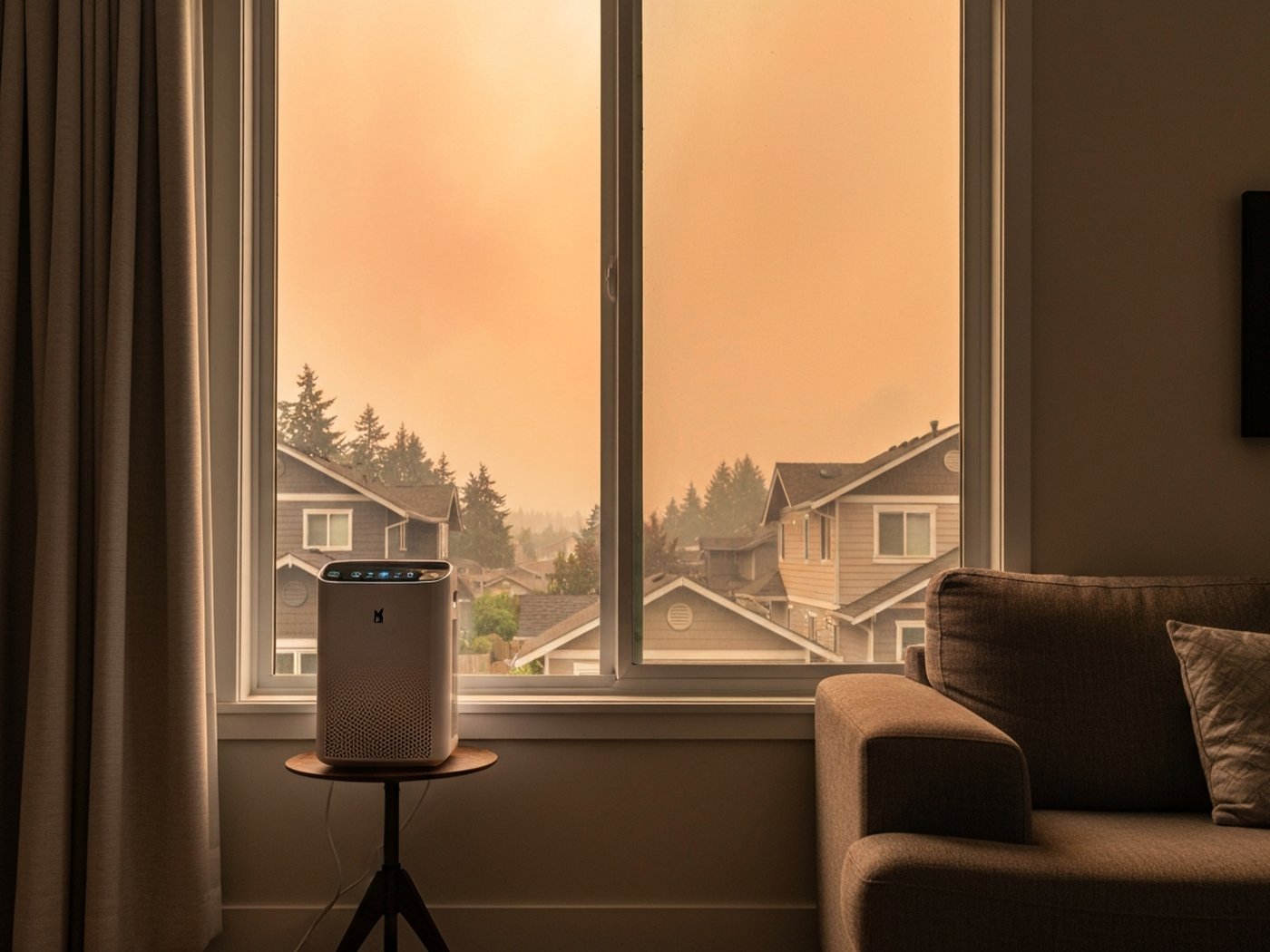
Most of my work is outside, at the roofline and foundation. But when smoke rolls in and the AQI hits 200, “harden the exterior” stops being the relevant conversation. The house becomes a shelter, and the question is how well it filters the air inside. That’s where a good air purifier earns its place, and where a bad one mostly runs quietly and does nothing.
Wildfire smoke is not the same problem as household dust, pet dander, or the VOCs off fresh paint. It is meaner, finer, and more chemically complex. This guide covers what to buy, how to size it, and what else you need to do inside when the smoke arrives.
Why wildfire smoke is a different air-quality problem
The health risk in wildfire smoke is primarily PM2.5, particles 2.5 microns in diameter or smaller. That is small enough to bypass your nose and upper respiratory tract and reach the bronchioles and air sacs deep in your lungs. The EPA, CDC, and California Air Resources Board all identify PM2.5 as the primary hazard in smoke events. Your nose is pretty good at catching pollen and coarse dust. PM2.5 it does not catch at all.
Then there is the chemistry. A forest fire is one thing. A wildfire that burns through a subdivision is a different beast: it is combusting plastics, treated lumber, roofing materials, and everything else in a modern structure alongside the trees. That releases formaldehyde, benzene, acrolein, polycyclic aromatic hydrocarbons, and a range of other gases and VOCs. These are not particles. They are molecules, and a HEPA filter, which is a mechanical particle barrier, does not stop them. A 2020 EPA study on indoor air quality during wildfire events specifically called out the need for carbon filtration alongside HEPA for these gas-phase pollutants.
If anyone in your house has asthma, COPD, cardiovascular disease, or is very young or elderly, the risk at moderate and high AQI levels is substantially greater. The CDC is direct about this in its wildfire smoke guidance. Confirm with a physician what thresholds apply to your household. What I can offer here is the equipment side.
The two filter types that actually matter for smoke
True HEPA. The standard: a filter that captures at least 99.97 percent of particles 0.3 microns in diameter. That specification matters because “HEPA-style” and “HEPA-type” are not specifications at all. They are marketing language with no binding meaning. When you’re evaluating a unit, look for the 99.97 percent / 0.3-micron claim backed by actual third-party testing. If a company does not publish that number, the filter may not meet it.
Activated carbon. This is the gas-phase side of the equation. Activated carbon works through adsorption: gases and VOCs bond to the enormous surface area inside the carbon’s porous structure. The amount of carbon in the unit matters enormously, and this is where most budget air purifiers quietly fail. A thin sheet of activated carbon pre-filter, the kind you’ll find in a $60 unit, does comparatively little. A unit with a deep bed of granular carbon pellets does a lot more. The Austin Air HealthMate, for instance, packs roughly 15 pounds of activated carbon and zeolite. The IQAir HealthPro Plus uses a mixed-media carbon bed as part of a multi-stage system. Units like these are meaningfully better at handling the gas-phase components of wildfire smoke, not just the particles.
The EPA’s own guidance on air cleaners and wildfire smoke recommends both HEPA and activated carbon for smoke events. That combination is not optional if you’re taking VOC exposure seriously.

Ionizers, ozone generators, and UV-C "purifiers" are not substitutes for HEPA and carbon. Some ozone generators produce ozone at levels harmful to the respiratory system, which is the opposite of what you want during a smoke event.
Sizing: why CADR is the number that matters
CADR stands for Clean Air Delivery Rate. It is expressed in cubic feet per minute and tells you how fast a unit delivers filtered air of a specific particle size into a room. The Association of Home Appliance Manufacturers (AHAM) certifies CADR for most major consumer brands, which makes it a standardized, cross-comparable number rather than a marketing claim.
The EPA’s general guidance is to choose a unit with a smoke CADR of at least two-thirds of the room’s square footage. A 300-square-foot room needs a smoke CADR of roughly 200 or higher. But during an active wildfire smoke event, you want more throughput than that baseline. The California Air Resources Board and a number of air quality researchers recommend targeting four to five complete air changes per hour during smoke events. To figure out what that requires: multiply your room volume (length x width x ceiling height, in cubic feet) by the target air changes per hour, then divide by 60 to get the required CFM. A 12-by-14-foot room with 9-foot ceilings is 1,512 cubic feet. Four changes per hour means you need about 101 CFM. Five changes per hour means about 126 CFM. Most mid-range units handle a bedroom fine by this math. The living room is where sizing tends to fall short.
One practical strategy: during a smoke event, pick the room your family will spend the most time in, close it off, and run a properly sized purifier there on high. One well-sized unit in a focused space beats an undersized unit trying to treat an open floor plan.
Options at different budgets
Here is how the commonly recommended units shake out for wildfire smoke specifically:
IQAir HealthPro Plus (around $900). Swiss-made, with a HyperHEPA filtration stage rated to 0.003 microns, plus a mixed-media carbon and alumina gas-phase stage. Independent evaluators including university air quality labs consistently rate it at or near the top for smoke. It is large, heavy, and loud at top settings. It is also the unit I would choose for a high-smoke-risk household where someone has respiratory or cardiovascular vulnerabilities.
Austin Air HealthMate (around $700). The carbon story here is the strongest of any consumer unit: 15 pounds of activated carbon and zeolite, plus a medical-grade HEPA element. Designed for gas-phase sensitivity as much as particulates. If chemical sensitivity or VOC exposure is the primary concern, this is where to look.
Coway Airmega 400 or 400S (around $300 to $400). Dual HEPA filtration with a carbon layer, smoke CADR around 350. A solid mid-range option for larger rooms. The carbon layer is thinner than the Austin Air or IQAir, so its particle performance is strong and its gas-phase performance is reasonable. The 400S adds WiFi and an app.
Winix 5500-2 and AM90 (around $150 to $200). True HEPA, thinner activated carbon, smoke CADR around 230. Good for a single bedroom. A reasonable option if budget is the constraint and the room is not large.
Levoit Core 400S (around $100 to $130). Popular on price, adequate for a smaller room, but the carbon filter is minimal. Acceptable for general air quality; not the first choice when VOC coverage matters.
Pricing fluctuates, and filter replacement costs matter for long-term ownership. Check that you can get replacement filters for whatever unit you buy. Replacement HEPA and carbon sets range from about $30 on budget units to $100 to $200 for IQAir and Austin Air.
The Corsi-Rosenthal box: a $60 option that genuinely works
During the COVID-19 pandemic, Dr. Richard Corsi and Matt Rosenthal developed a DIY air filtration cube built from a 20-inch box fan and four MERV-13 furnace filters taped into a box shape around the fan. The EPA tested it and found real particulate-reduction performance at very low cost. Cal Fire and several county health departments have included it in wildfire smoke guidance. A comparable setup costs roughly $50 to $70 depending on filter prices.
Its limits: MERV-13 has no activated carbon, so it addresses particles but not gases or VOCs. It is large and noisy. But if you’re caught without a dedicated purifier during a smoke emergency, it is a legitimate option for cutting PM2.5 in a room. The EPA and the Corsi-Rosenthal Foundation have published instructions freely.

Run your purifier on high during an active smoke event even though it is noisier. Air changes per hour drop significantly on medium or low settings, and the extra filtering is exactly when it matters most.
Sealing the house and what else to do during a smoke event
An air purifier can only work with what is inside the house. During a smoke event, wildfire smoke infiltrates through gaps around windows and doors, open fireplace dampers, bathroom exhaust fans, dryer vents, and any unsealed penetrations. Close the damper on any wood-burning fireplace before smoke season starts. Keep bathroom and kitchen exhaust fans off during heavy smoke unless you absolutely need them. Weatherstripping and door sweeps reduce baseline infiltration meaningfully.
Your HVAC system requires a judgment call. Running it on full recirculation mode with a MERV-13 or better filter installed can supplement your purifier by cleaning recirculated air. The critical check: confirm your system is set to recirculate only, not draw fresh outdoor air. If your system has an economizer that pulls outside air when conditions seem favorable, a smoke event is when that feature works against you. An HVAC technician can confirm your system’s configuration if you’re not sure. A clogged or low-quality filter in the air return is the other common failure: it limits airflow and does little filtering.
Avoid adding indoor pollution when outdoor air is already compromised. Gas stoves, candles, and incense all contribute combustion products to the air you’re trying to keep clean. Even vacuuming raises settled particulates. Ready.gov’s shelter-in-place guidance covers the basics, and they’re worth reading before a smoke event, not during one.
If smoke is entering your house partly because the building envelope has gaps and air sealing issues, that is worth addressing during calmer months. It is part of the broader wildfire home hardening conversation, and a tighter house is a safer house in more ways than one. The full preparation picture, including go-bags, evacuation levels, and early-season prep, is in the wildfire preparedness checklist.
How often to replace filters during smoke season
A HEPA filter loaded with particulates loses filtration efficiency before it fails completely. Most consumer units have a filter-life indicator, but those are time-based estimates, not actual measurements of what the filter has captured. During a summer with sustained heavy smoke, your HEPA element will load faster than it would in an ordinary year.
Check the filter visually if your unit allows access. A gray or brown element is well-loaded. The carbon layer is harder to evaluate visually because it exhausts its adsorption capacity through a chemical process you cannot see. The signal for a spent carbon layer is usually that your house still smells smoky with the purifier running. Replace the filter set when that happens, not on the next scheduled reminder.
For a heavily used unit in a high-smoke area, plan on one to two filter set replacements per smoke season. Factor that into the total cost of ownership when comparing units.
FAQ
At what AQI level should I run my air purifier on high?
AirNow.gov uses a scale where 0 to 50 is Good, 51 to 100 is Moderate, 101 to 150 is Unhealthy for Sensitive Groups, 151 to 200 is Unhealthy for all, and above 200 is Very Unhealthy to Hazardous. For sensitive individuals, the EPA and state health departments generally advise precautions beginning at 101. My practical take: start running the purifier any time outdoor AQI from wildfire smoke reaches 100, and switch to high at 150. At 200 and above, CDC and Ready.gov guidance moves to active shelter-in-place, which means closed house, purifier on high, and limiting physical activity that deepens your breathing.
Can I just use my HVAC system instead of buying a dedicated purifier?
With a MERV-13 or better filter on full recirculate, your HVAC can contribute meaningfully to indoor air quality during a smoke event. But it is not a straight replacement for a dedicated purifier. Central air moves more volume, which is good, but the filtration density in a furnace filter is lower than true HEPA. More importantly, you have to confirm the system is not pulling outdoor air. A combination works best: HVAC on recirculate with a quality filter, plus a dedicated HEPA unit in the room where people spend the most time.
How long do HEPA filters last during wildfire smoke events?
Under normal use, most consumer HEPA filters last one to two years. During heavy smoke season, the filter loads faster because the particulate concentration is much higher than typical indoor air. There is no universal answer; it depends on how many hours per day you run the unit, the local smoke density, and the filter size. Inspect it periodically if you can, and plan for at least one replacement per year if you run the unit heavily from June through October.
Do ionizers or UV-C purifiers work for wildfire smoke?
Not in the way HEPA and carbon do. Ionizers work by charging particles so they stick to surfaces, which removes them from the air but deposits them on walls and furniture rather than in a filter. Some ionizers produce ozone as a byproduct, which is a respiratory irritant, compounding the problem during a smoke event. UV-C light deactivates biological contaminants like bacteria and mold spores, but does nothing for PM2.5 particles or VOCs. For wildfire smoke, stick to true HEPA combined with activated carbon.
Related guides
After the Wildfire: Filing Your Insurance Claim
A step-by-step guide to filing a wildfire insurance claim: what to document, how the adjuster process works, and when to push back on a low estimate.
Read the guide →Wildfire Preparedness Checklist for Homeowners
A practical wildfire preparedness checklist covering defensible space, home hardening, evacuation planning, and insurance documentation.
Read the guide →Wildfire Evacuation Levels Explained (Ready, Set, Go)
Know what Ready, Set, and Go actually demand of you before the next wildfire alert hits your phone, because Level 3 is too late to start planning.
Read the guide →Keep ignitable debris out of your roofline
Get a free, no-obligation LeafFilter gutter-protection assessment. Fine micro-mesh keeps leaves and pine needles out of the gutters, the spot where wind-blown embers love to land. Booking through us supports this site.
Get a free LeafFilter assessment →