Defensible Space: The 0 to 5 to 30 to 100 Foot Zones, Explained
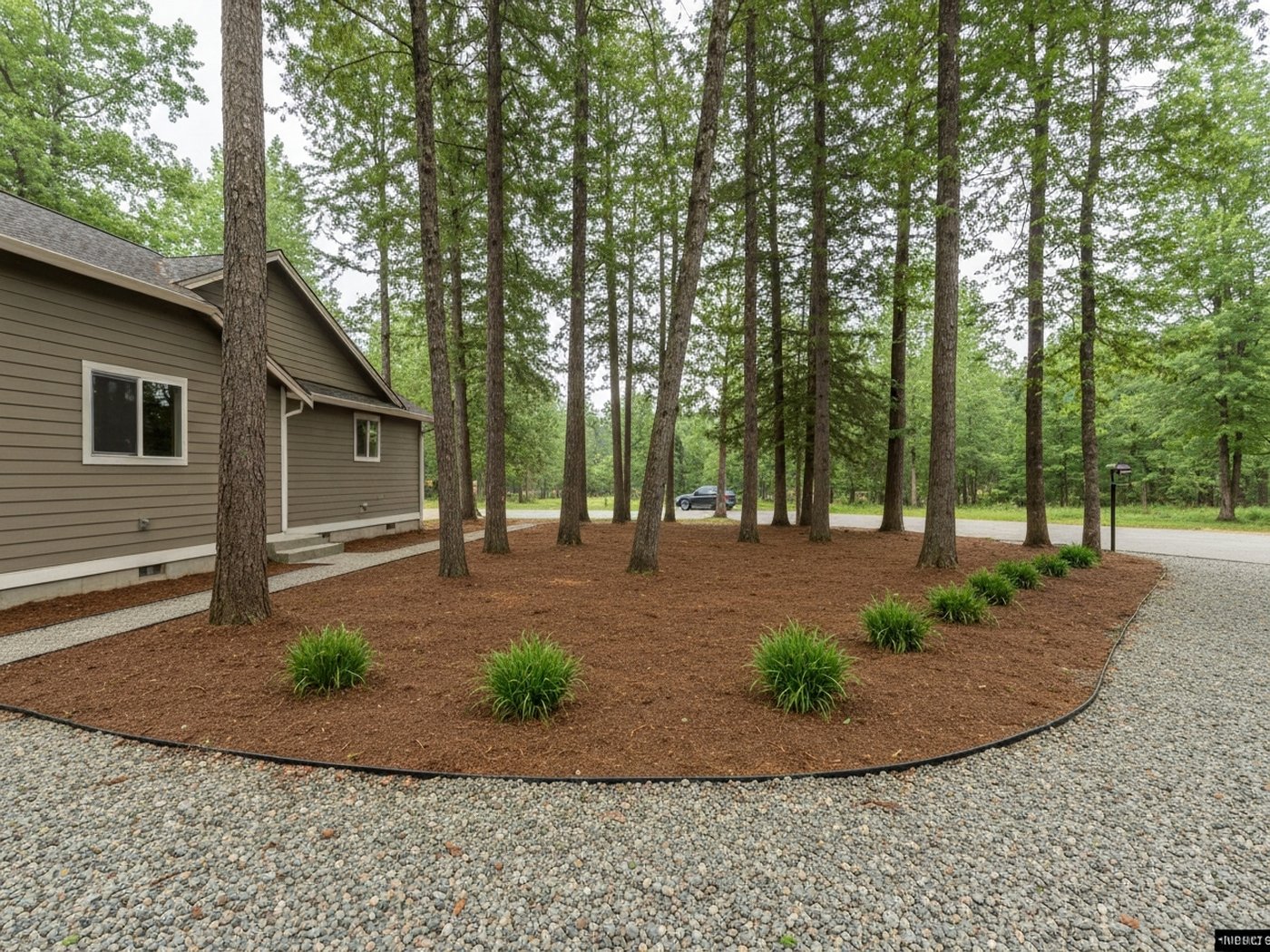
The zone framework originated with California’s State Board of Forestry in the 1980s and eventually got written into the California Public Resources Code as a legal requirement. NFPA’s Firewise USA program, IBHS, and Ready.gov all adopted the same basic structure, which is why you see those same numbers (5, 30, 100) in federal mitigation guides, insurance checklists, and state fire plans.
Knowing the numbers is step one. Knowing what to actually do in each zone is where most people get stuck.
Zone 0: the first 5 feet
Zone 0 is the smallest zone and the one that matters most per square foot. It’s the noncombustible perimeter right against the house, and it exists because of how homes actually ignite in wildfire.
The image most people have is a flame front rolling over a house. That isn’t usually how it happens. IBHS and Cal Fire research, confirmed by post-fire assessments going back to the 2003 Southern California fires, shows the same pattern: embers blown ahead of the fire front are the primary ignition mechanism. They travel on wind, sometimes for a mile or more, and settle onto and around homes that are nowhere near the flames yet. If those embers find dry material in contact with the structure, the house can begin burning on its own.
Zone 0 is your response to that. Nothing combustible should be touching or directly against the house. In practice, that means:
- Replace wood mulch within five feet of the foundation with gravel, decomposed granite, or other noncombustible material
- Clear dead leaves, pine needles, and debris away from the foundation, from window wells, and from any gap where material can accumulate
- Move combustible furniture, doormats, potted plants in wood planters, and stored firewood away from the walls
- Inspect under decks and open staircases; those spaces collect dry debris and are hard to clear in a hurry
Ember-resistant vents belong in Zone 0 as well. An attic or crawlspace vent that admits embers is a hidden ignition point; by the time it’s smoldering inside, it’s often too late. IBHS has published specific ember-resistance testing standards for vents, and Firewise USA recommends replacing standard screens with fine-mesh ember-blocking covers as a high-priority upgrade.
Siding condition matters here too. Combustible siding (vinyl, cedar, untreated wood) at the foundation is in the same risk category as wood mulch. Fiber cement, stucco, and masonry siding perform meaningfully better in direct ember contact because they don’t give embers something to start with.

Wood mulch looks good and holds moisture, but it's dry fuel in late summer when fire risk peaks. In Zone 0, replace it with gravel or decomposed granite against the foundation.
Zone 1: 5 to 30 feet
If Zone 0 is about removing ignitable material from the structure, Zone 1 is about keeping a fire from sprinting across your landscape and arriving at the house with full momentum. Cal Fire describes it as “lean, clean, and green,” which is actually a useful three-word spec.
Lean means plants are low-growing, widely spaced, and don’t form a continuous fuel bed. Trees in Zone 1 should have at least 10 feet of horizontal clearance between canopy edges so fire can’t jump from crown to crown. Grass should stay under 4 inches and be irrigated through fire season. The goal is fuel discontinuity: if fire enters Zone 1, it should have to work hard to find the next thing to burn.
Clean means dead material is gone. A dead shrub is dramatically more dangerous than a living one. Dead woody debris, unmowed dry grass, fallen branches, and accumulated leaf litter are all higher-risk fuels. After the wet season ends, Zone 1 needs a sweep.
Green means actively irrigated and healthy. Plant selection matters here more than most people want to hear. Junipers, ornamental rosemary, and tall ornamental grasses are common Zone 1 plantings, and all three are genuinely problematic in fire country. They hold volatile oils and dry out in a fire wind; they burn fast and hot. Low-water-use natives, succulents, and widely spaced irrigated ornamentals perform better. State cooperative extension services publish fire-resistant plant lists specific to your region: UC Cooperative Extension in California, CSU Extension in Colorado, OSU Extension in Oregon. Your county’s list will be more useful than any generic “fire-safe plants” roundup.
Tree limbs should be pruned up from the ground to at least 6 to 10 feet throughout Zone 1. This breaks the ladder fuel connection between ground-level fire and the tree canopy. Shrubs growing under tree canopies should also be thinned or removed for the same reason.
Zone 2: 30 to 100 feet
Zone 2 is not about stripping the land bare. It’s about reducing the density and continuity of fuels so that any fire entering from beyond your property loses energy before it gets to Zone 1. The goal is a slower, lower-intensity fire, not zero fire.
Main tasks in Zone 2:
- Mow or cut grass seasonally, especially after it dries out in late summer
- Remove dead trees, standing snags, and dense brush pockets
- Space tree canopies so they have at least 10 feet of separation, more on steeper slopes
- Prune lower limbs to at least 6 feet off the ground throughout the zone
- Remove the mid-level shrubs and plants that create ladder fuels connecting ground to canopy
Slope is a real multiplier here. Fire travels faster uphill, and IBHS research notes that homes on steep south-facing slopes face elevated risk because both flame spread and ember production increase on grades. Cal Fire guidance and most state equivalents recommend more aggressive fuel reduction in Zone 2 when slopes exceed 30 percent. Some fire-safe councils in the Sierra Nevada recommend treating steep-slope Zone 2 with roughly 50 percent more intensity than flat-ground guidance suggests.
What “100 feet” means on a small lot
A lot of homeowners in fire-risk areas are working with lots smaller than 100 feet deep. If your property line is 60 feet from the house, you physically can’t create 100 feet of defensible space on your own, and the rules account for this.
California’s Public Resources Code requires clearing to the property line, not beyond it. Most state equivalents follow the same logic. Fire agencies will evaluate and cite you for what’s on your lot; they can’t expect you to manage a neighbor’s land.
The neighbor question comes up often. If trees on adjacent property overhang your Zone 1, you typically have the legal right to trim to your property line, though local ordinances vary and it’s worth confirming before you cut anything. In fire-prone neighborhoods, proactive conversations with neighbors about coordinated fuel reduction are common and sometimes organized through Firewise USA community programs, which can also access grant funding to help offset costs.
On a small lot, concentrate the serious effort on Zone 0 and Zone 1. Ember-driven ignition happens right at and against the structure. Getting Zone 0 right is meaningful even when Zone 2 is constrained by your property line.

If you can't reach 100 feet, nail the first 30. Ember ignition starts at the structure, and a clean Zone 0 and Zone 1 cut that risk substantially even when your lot doesn't stretch to 100 feet.
The roofline is Zone 0 too
The zone framework is primarily written as a ground-level land-management system, which is correct. But embers don’t stop at the lawn. They land on roofs, collect in valleys, drift into vents, and pile up in gutters. The roofline is as much a part of Zone 0 as the foundation perimeter.
This is territory I know from field assessments. A gutter loaded with pine needles, leaf debris, and shingle grit is a strip of dry, fine fuel running the full perimeter of the house, pressed against the fascia and the roof edge. That seam, where the roof meets the vertical fascia below it, is where an ember landing in a full gutter has everything it needs: fuel, a structural surface, and airflow. I’ve pulled what amounts to kindling out of gutters in August, the worst possible time. IBHS, Cal Fire, and Firewise USA all flag the roofline and gutters specifically as a Zone 0 concern, not just a maintenance nicety.
Two approaches: clean gutters before fire season (before they go dry, not during a red-flag event in September when it’s already too late), or install a fine stainless micro-mesh guard that keeps debris from accumulating in the first place. The full home hardening guide covers the roofline in detail, alongside vent covers, roof fire rating, and the other structural details that determine whether a house survives an ember assault.
State laws and local enforcement
Cal Fire enforces defensible space requirements through inspections in California’s State Responsibility Areas, with fines that can reach several thousand dollars and liability implications if a fire is connected to a violation. Oregon, Colorado, Nevada, and a growing number of other states have their own defensible space statutes tied to their high-hazard classifications. The specific distances, vegetation standards, and enforcement mechanisms vary by state, by county, and sometimes by municipality.
Beyond the rules, many fire agencies do proactive inspections, especially in the years following fires that draw attention to a region. A Firewise USA community designation can provide a neighborhood-level framework for fuel reduction and sometimes creates leverage for grant funding to offset costs.
Some communities have gone beyond the state standard. Parts of the Lake Tahoe basin, areas in Santa Barbara County, and several Colorado communities have adopted requirements that extend to 200 feet or more on certain parcels. The only reliable way to know what applies to your property is to check with your local fire department, county fire safe council, or state forestry division.
How defensible space connects to your homeowners insurance is worth knowing too. Some carriers are beginning to differentiate availability and pricing based on property-level hardening. In California, admitted insurers are required under the state’s “Safer from Wildfires” framework to offer discounts tied to mitigation measures, and an IBHS “Wildfire Prepared Home” designation can help you document your work to a carrier. Whether a discount applies, how much it is, and what documentation is required varies by insurer and state, so ask your own carrier directly rather than assuming. The wildfire home insurance guide covers the insurer side of this in more depth. This post is educational context; for guidance specific to your situation, talk to your insurer and your state Department of Insurance.
Frequently asked questions
What is Zone 0 in defensible space? Zone 0 is the noncombustible buffer from zero to five feet around the structure. Nothing ignitable should be in contact with the house: no wood mulch, no dry debris, no combustible items against walls, no firewood stacked at the foundation. Ember-resistant vent screens are a Zone 0 upgrade too, since vent openings are a common and underappreciated entry point for embers. Cal Fire and IBHS both treat Zone 0 as a distinct priority because it addresses the ember ignition threat directly at the structure, which is where most wildfire home loss actually originates.
How do I create defensible space on a small lot? Clear Zone 0 completely first; it’s the highest-priority work and it’s doable on any lot size. Then tackle Zone 1 (5 to 30 feet) as thoroughly as your lot allows. If your property line cuts off before 100 feet, go to your line and stop; that’s what the law requires in most states. For trees on neighboring property that overhang your Zone 1, check your local ordinance, but you typically can trim to your property line. Proactive conversations with neighbors about coordinated fuel reduction are worth having, and your county fire safe council may have resources to help.
Does defensible space actually help? Yes, consistently. Post-fire building assessments, including IBHS’s systematic studies comparing survivors and losses within the same fire perimeter, show that homes with maintained defensible space have meaningfully higher survival rates when other factors (roof class, construction type) are held roughly equal. Defensible space doesn’t eliminate risk; ember travel means ignition can occur even with excellent clearance. But the evidence for its effectiveness is strong enough that fire agencies enforce it and insurers are increasingly recognizing it.
What are ladder fuels and why do they matter? Ladder fuels are the mid-height vegetation between ground level and the tree canopy that allows a ground fire to climb into the treetops and become a far more intense canopy fire. Tall shrubs growing beneath trees, unpruned lower limbs, and dense mid-height brush are the main examples. Removing them in Zones 1 and 2 is one of the highest-impact fuel reduction steps because it keeps any ground fire from escalating. Prune tree limbs up from the ground to at least 6 feet throughout those zones, and thin or remove shrubs growing under tree canopies.
Related guides
Class A Roofing Shingles: The Fire-Rated Choice for Asphalt Roofs
Class A asphalt shingles carry the highest fire rating for roofing in the US and are the baseline for any wildfire-resilient roof in a fire-prone state.
Read the guide →What Is a Class 4 Roof? Impact Resistance and Insurance Savings
A Class 4 impact-resistant roof can earn meaningful insurance discounts and adds roofline durability, but it is not the same as a fire rating. Here is what to know.
Read the guide →Class A Roof Assembly: How the Whole System Earns Its Rating
A Class A fire rating applies to the whole roof assembly, not just the shingles, and understanding the difference changes how you approach re-roofing in fire country.
Read the guide →Keep ignitable debris out of your roofline
Get a free, no-obligation LeafFilter gutter-protection assessment. Fine micro-mesh keeps leaves and pine needles out of the gutters, the spot where wind-blown embers love to land. Booking through us supports this site.
Get a free LeafFilter assessment →