Brush and Wildfire Gutter Guards: Keeping Embers Out of the Roofline
One quick note on terminology: in the gutter industry, “brush guard” can mean a bottle-brush style insert that sits inside the trough. Those are not what this article recommends, and I’ll explain why shortly. When I say “brush” here I mean the wildland scrub, chaparral, oak woodland, and mixed vegetation that surrounds homes in fire-prone areas and fills gutters with debris every season.
I do in-home exterior assessments as a gutter and water-management consultant. In the past couple of years most of my calls have come from homeowners in wooded or scrubland-adjacent settings who are thinking harder about fire than they used to. The roofline conversation always comes up, and it usually circles back to the gutter.
Why the roofline gutter is a fire vulnerability worth fixing
Homes in a wildfire mostly don’t ignite from a wall of flame rolling across the yard. The Insurance Institute for Business and Home Safety (IBHS) has studied this systematically across hundreds of fire-damaged structures, and the result is consistent: wind-blown embers, not direct flame contact, are the primary cause of home loss in wildfire. Those embers can travel a mile or more ahead of the fire front. They drift down and look for something dry to catch.
A gutter packed with dried brush debris is a textbook ember landing pad. The material settles into the trough, compacts over time, and by late summer it is as dry as anything on the forest floor below the house. It sits directly against the fascia board and at the lower edge of the roof sheathing, which is one of the most vulnerable seams in the building envelope. An ember finds that debris, smolders in it, and the heat works upward and outward from there.
This is why gutter and roofline maintenance shows up on official home-hardening checklists. Firewise USA (an NFPA program) includes it. Cal Fire includes it. The California Building Code and the state’s “Safer from Wildfires” insurance framework both address ember-resistant roofline detailing specifically. The gutter is not a minor footnote in wildfire preparedness. It is where I tell homeowners to look first.
What brush debris actually looks like in your gutter
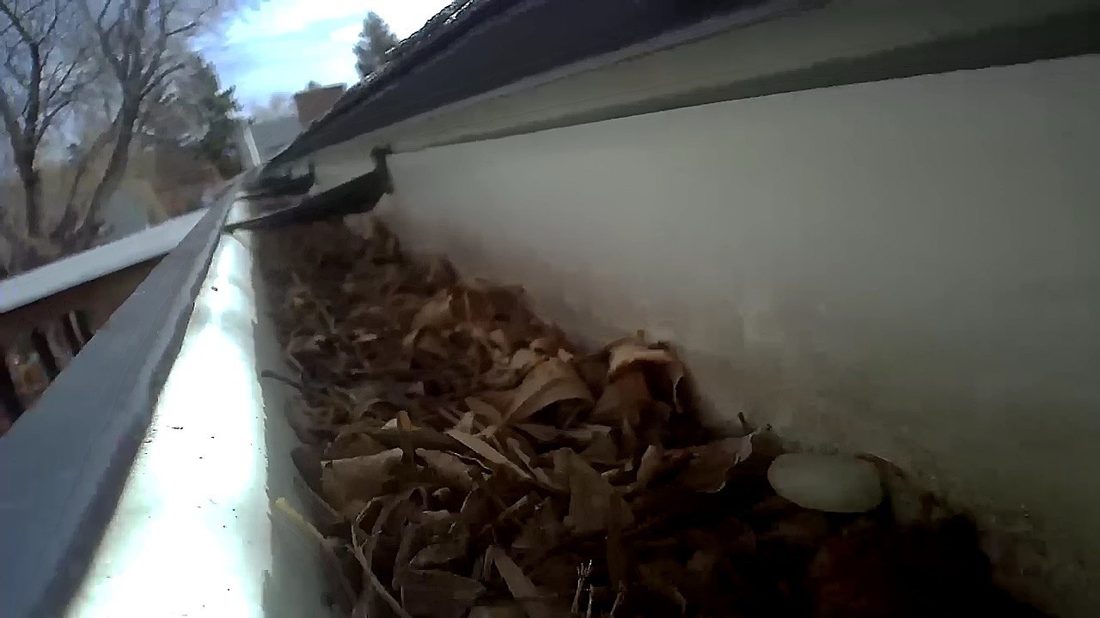
The debris profile varies by region, but the fire-zone pattern is similar everywhere.
In Southern California’s foothill zones, gutters collect dried chamise, ceanothus leaves, toyon bits, and bark shreds from nearby sycamore or eucalyptus. In the Texas Hill Country, live oak clusters and cedar shag are the usual culprits. In Colorado foothills it is gambel oak, chokecherry, and bark from ponderosa pines at the forest edge. Along the Oregon and Northern California coast ranges, tanoak and madrone mix with dried grass seed heads and shredded bark.
What these all have in common during fire season: they are small, dry, and light enough to blow into an open gutter from a considerable distance. A gutter that is reasonably clean in April can carry a meaningful debris load by Labor Day, which is exactly when late-season fire risk peaks in most of these climates. The fine, irregular particles, bark flakes, dried grass heads, and small leaf fragments, are the ones that matter most, because they are what a standard coarse screen fails to intercept and what settles deepest into the trough.

A gutter you cleaned in spring can be carrying a significant fuel load by mid-summer. An inspection in July or early August, before peak fire season, is worth adding to your calendar.
Guard types: what works and what does not
The guard type you choose matters more in a fire zone than it does in a low-risk area, because the stakes of getting it wrong are higher.
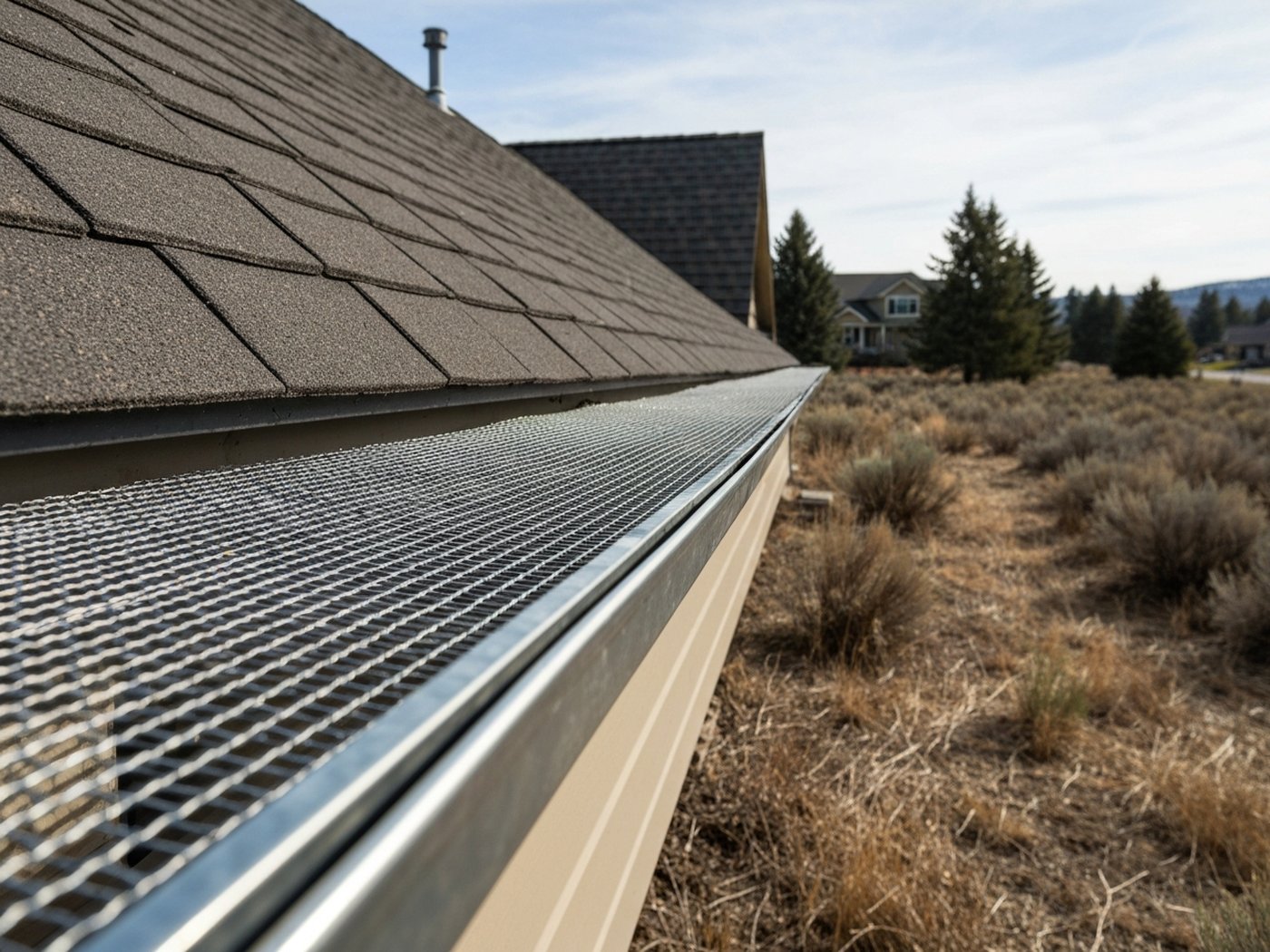
Fine stainless micro-mesh on a rigid metal frame (best choice). The fine woven or perforated stainless mesh is what does the actual work here. It keeps out not just large leaves but the small bark shreds, dried grass material, and fine chaparral debris that constitute the real fire-season accumulation. Stainless steel is noncombustible, which matters when you’re thinking about what sits at the edge of your roof. A good installation is fitted flush against the roof and fascia with no gaps at corners, valleys, or downspout inlets. Those seams are where fine debris reliably works its way back in. This is the type I’d put on a fire-zone home without much hesitation.
Surface-tension / reverse-curve guards. Metal hoods work by letting water wrap around a nose and into the gutter while debris is supposed to shed off the outer surface. They handle large flat leaves reasonably well, and if they are all-metal they are noncombustible. The problem is fine dry material. Bark shreds and dried chaparral bits are light enough to ride the water film around the nose and drop in, or pile on the hood surface and get blown into the gutter at the edges during a wind event. Serviceable for a home with mostly large-leaf debris from a single deciduous tree. Less ideal for mixed fine brush.
Standard screens (coarse perforated or stamped metal). The openings on a standard screen are far too large to stop small fire-zone debris. Metal screens are noncombustible, which is something, but they solve neither the debris exclusion problem nor the ember-fuel problem. For a brush-fire zone, this is not enough.
Foam and brush (bottle-brush) inserts. These sit inside the trough rather than covering it, and they trap debris rather than excluding it. Fine dry material works into foam pores and bristles, packs down, and becomes harder to clean out than a bare gutter would have been. The combustibility problem makes it worse: open-cell foam is burnable material placed at exactly the spot where embers collect. I would not install these products on a fire-zone home. The product description sounds low-maintenance; the reality is a compressed fuel mat sitting in the gutter.

Ask any installer or manufacturer for the actual pore size of the mesh, measured in millimeters. A true micro-mesh has openings below one millimeter. If you cannot get a number, that is a red flag.
What to look for in a wildfire-zone gutter guard
When fire is part of the risk calculation, a few specifications rise to the top:
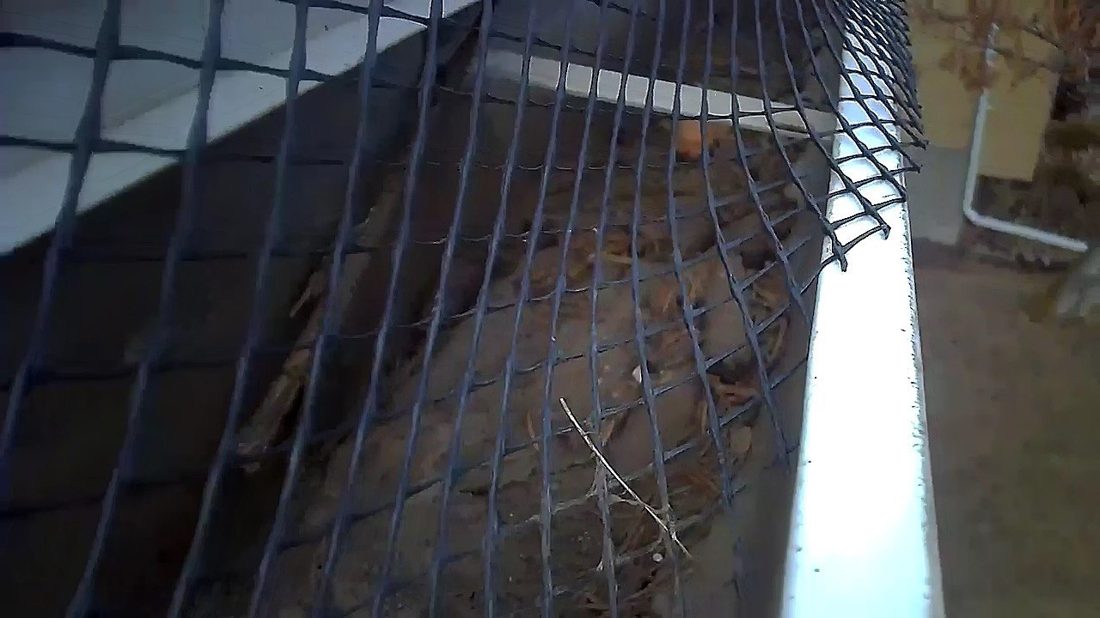
Noncombustible materials throughout. The mesh, frame, clips, and fasteners should all be metal. No plastic mesh, vinyl frame components, or foam elements anywhere in the assembly.
Genuinely fine micro-mesh, not coarse screen. A woven or perforated stainless mesh with openings small enough to catch bark shreds and fine grass material. If the product is described as a “screen” rather than “micro-mesh,” the pore size is probably too large for fire-zone brush debris.
Rigid frame and correct pitch. A panel that sags or sits flat rather than following the roof pitch becomes a debris shelf. Debris sits on top instead of shedding off, and wind pushes it into the gutter at the seam. The frame’s job is to hold the mesh taut and at the right angle.
Tight coverage at seams, corners, valleys, and downspout openings. This is almost always the failure point in a real installation. Valleys and inside corners are where debris piles deepest. A gap there undoes the performance of the rest of the guard. It is also where you lose the fire-defense benefit, because those packed spots are the highest-risk ignition points.
Compatibility with your roof. Some micro-mesh systems are installed by inserting a lip under the first course of shingles. Done carefully, this works. Done badly, it lifts shingles, creates water intrusion paths, and can void your roofing warranty. Confirm with any installer how they handle the roof edge, and check whether your roof manufacturer has a position on it.
For insurance purposes, document what you install: dated photos, the product spec sheet, the installation receipt. State programs like California’s “Safer from Wildfires” framework and third-party designations like IBHS’s “Wildfire Prepared Home” program are designed to recognize roofline hardening work. Whether a gutter guard installation qualifies for a premium discount or influences your policy’s underwriting depends on your carrier, your state, and your specific policy. Confirm those details directly with your insurer and your state Department of Insurance. This is educational context, not professional insurance advice. For the broader coverage picture, the wildfire home insurance guide is where to start.
Professional install vs. DIY
Both paths are legitimate, and the right choice depends on the house.
On a single-story home with straight, accessible runs and nothing complicated at the roofline, a careful DIY installation of a hardware-store stainless micro-mesh panel is a reasonable project. The quality ceiling on consumer-grade products is lower than professional systems, but the right product installed carefully beats a sloppy professional job.
Where I push homeowners toward a professional: two-story homes, steep pitches, tile or cedar shake roofing that is easy to crack underfoot, and homes with a lot of valleys and inside corners. These are places where installation accuracy matters and where a mistake is expensive. A professionally installed system also typically comes with a clog guarantee and a workmanship warranty, which doubles as useful documentation if you are making a case to your insurer.
When homeowners ask what I recommend on the professional side, I point them toward fine stainless micro-mesh systems with a solid track record. LeafFilter is the one I most often refer and book homeowners through. The surgical-grade stainless mesh hits the noncombustible, fine-pore spec you want in a fire zone, and a professional installation covers the corner and seam details that a DIY job tends to miss. To be clear: I refer and book homeowners through LeafFilter but do not install it myself. A DIY fine metal micro-mesh guard is a genuine option too, as long as it meets the same standard: noncombustible, genuinely fine pore, rigid frame, and tight at the seams.
The gutter guard is one piece of a larger roofline strategy. For what else belongs on that list, the wildfire home hardening guide covers vents, roof class, Zone 0 clearance, and the correct sequence to work through them. Keeping the gutter fuel-free fits into that larger picture at the roofline, right alongside ember-resistant vents and a Class A roof surface. And if pine needles are specifically your main debris type, that scenario gets its own detailed treatment in best gutter guards for pine needles and fire debris.
FAQ
Are brush-style gutter inserts safe to use in a fire zone? No, I would not use them in a fire-risk area. The bottle-brush or pipe-cleaner inserts sit inside the gutter trough and trap debris rather than excluding it. Fine dry material works into the bristles and compacts over time, creating a compressed fuel mass at the roofline, which is exactly the opposite of what you want. Standard open-cell foam inserts share the same problem, with the added issue that foam is combustible. In a wildfire-prone area, your guard should be noncombustible metal mesh that covers the opening, not a material that sits inside it.
How is a wildfire gutter guard different from a regular gutter guard? The difference is mainly in material and pore size. In a fire zone, the guard assembly needs to be noncombustible metal throughout: no plastic mesh, no vinyl frames, no foam components. It also needs fine enough openings to intercept the small, dry debris that chaparral, oak woodland, and mixed scrubland produce, not just whole leaves. A standard coarse-screen guard keeps out tennis balls and big leaves but lets fine bark and dried grass material through. The functional requirements happen to overlap with what you need for pine needles: fine stainless micro-mesh on a rigid metal frame.
Can a gutter guard lower my wildfire insurance premium? It might, depending on your insurer, state, and policy, but I cannot tell you what your specific policy will do. What I can say is that roofline debris management is exactly the kind of hardening work that programs like California’s “Safer from Wildfires” framework and IBHS’s “Wildfire Prepared Home” designation are designed to credit. Whether that translates to a discount, an underwriting preference, or nothing in particular for your situation is a question for your carrier and your state Department of Insurance. Document the installation thoroughly regardless: photos, the product spec, the receipt. That documentation has value whether or not a formal discount applies.
How often does a micro-mesh guard need maintenance in a brushy yard? Far less than a bare gutter, but not zero. A good fine micro-mesh system keeps the inside of the trough clear indefinitely. The maintenance that remains is a periodic inspection and rinse of the mesh surface itself, where fine grit and pollen can build a film over time, and a check of the seams and downspout openings after a heavy wind event. In a brushy yard, I would do that walk-around inspection in late spring and again in July before peak fire season: run a hose over the mesh surface, look at the corners and valleys, make sure no debris has bridged a gap. That is a very different workload from digging out a packed bare gutter in August.
Related guides
Best Ember-Resistant Vents for Wildfire Defense
Ember-resistant vents protect soffit, attic, and foundation openings from the burning brands that cause most wildfire home losses.
Read the guide →Are Gutter Guards Worth It in a Fire Zone?
In a wildfire zone, gutter guards are worth it if you get the right kind: noncombustible metal micro-mesh that keeps ignitable debris out of your gutters for good.
Read the guide →LeafFilter Cost: What You'll Pay and Whether It's Worth It in a Fire Zone
What LeafFilter actually costs per linear foot and why a fire-prone home changes the worth-it math on professional micro-mesh installation.
Read the guide →Keep ignitable debris out of your roofline
Get a free, no-obligation LeafFilter gutter-protection assessment. Fine micro-mesh keeps leaves and pine needles out of the gutters, the spot where wind-blown embers love to land. Booking through us supports this site.
Get a free LeafFilter assessment →