Are Gutter Guards Worth It in a Fire Zone?
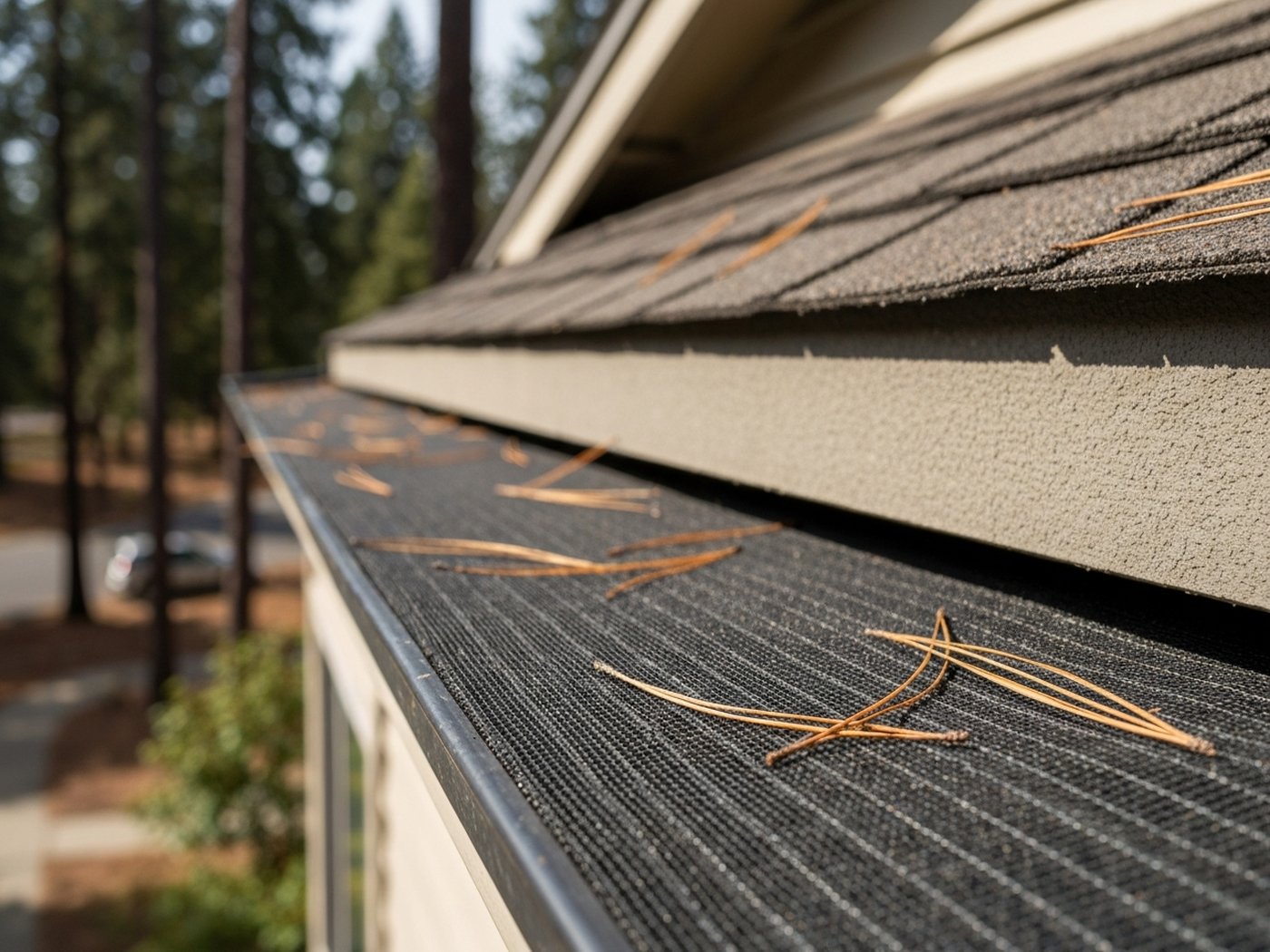
The question comes up a lot when I’m doing gutter assessments in fire-prone neighborhoods, and I understand the hesitation. Guards range from cheap and mediocre to expensive and genuinely excellent, and marketing copy doesn’t always help you tell the difference. What I can tell you is that in a fire zone, the calculation shifts. It’s not just about reducing gutter-cleaning trips. It’s about what happens to your house when an ember shower comes through.
Why gutters become a fire hazard
Most homes in a wildfire don’t burn because a flame front rolls directly over them. That’s actually rare. What usually happens is that embers blow ahead of the fire, sometimes miles out ahead, and drift down like burning snowflakes looking for fuel. IBHS (the Insurance Institute for Business and Home Safety) has documented this extensively, and Cal Fire’s home-hardening materials say the same thing: ember intrusion is the leading cause of home loss in wildfire events, not direct flame contact.
So where do those embers land? They hit roofs. They find vents. And they collect in debris.
Your gutters are the single worst accumulation point on the exterior of the house. A full season’s worth of pine needles, leaves, and grit dries out by late summer into fine, combustible material, and it runs the entire perimeter of your roofline. It sits right up against the fascia board, an inch from the sheathing edge, at the exact seam where roof meets wall. That seam is the most vulnerable spot on the house. An ember dropping into a loaded gutter has everything it needs: dry fuel, a little airflow through the open gutter channel, and structural wood within reach.
I’ve pulled what amounts to tinder out of gutters in September, just before the worst of fire season. People spend serious money on a Class A roof and then let a band of dry debris ride along its edge for months. NFPA’s Firewise USA program and IBHS both put the roofline in the same priority tier as vents and roof material, which is why it shows up prominently in our wildfire home hardening checklist.
What a gutter guard actually does in this context
The fire-zone case for a guard is narrower and more specific than the general pitch. It’s not just “less cleaning.” It’s this: the gutter stays empty of dry, ignitable material between cleanings.
If the guard works, there’s no fuel for an ember to find. The gutter does its job (channels water off the roof and away from the foundation) without becoming a fuel strip at the roofline. That’s the value proposition in a fire zone, and it’s real.
The qualifier matters, though. “If the guard works.” Not all of them do, and in a fire zone the ones that fail are sometimes worse than having nothing.

Foam and brush inserts are combustible. Installing them in your gutters trades one problem for a worse one: now you have burnable material sitting permanently at the roofline, regardless of whether pine needles get in.
Which guards clear the bar
For a fire zone, I’d hold any guard to two criteria before anything else:
First, noncombustible materials throughout. The guard is sitting over your gutter at the roofline. If any part of it can ignite, you’ve installed fuel at the spot you’re trying to protect. That rules out foam inserts, brush inserts, and any guard with a plastic mesh surface. Fine stainless steel mesh is what earns the rating here: it doesn’t burn, handles UV, and holds up to heat without degrading.
Second, fine enough openings to actually keep debris out. This is where a lot of cheaper guards fail. Coarse screens with large holes let pine needles and shingle grit right through. Reverse-curve hoods work reasonably on flat leaves but have a well-known failure mode with needles: they’re thin and light enough to ride the water around the curve and drop in. If debris can still accumulate in your gutter, the guard hasn’t solved the fire problem. It’s just made the gutter harder to access when you need to clean it.
Fine stainless micro-mesh, mounted on a rigid frame, hits both marks. The mesh openings are small enough to stop needles and grit. Stainless won’t corrode or burn. And rigid framing matters because a guard that sags into the gutter becomes a debris shelf. You want it taut and pitched so rain runs through and surface debris blows or washes off on its own.
I went deeper on the type-by-type comparison in the best gutter guards for pine needles and fire debris post, including how foam and brush inserts fail specifically and why reverse-curve hoods underperform on needles. The short version for a fire zone: stainless micro-mesh is the only type I’d call genuinely worth it. The others come with caveats that get more serious, not less, when fire risk is the reason you’re shopping.

Ask any salesperson two things before buying: what is the mesh pore size, and is it stainless steel? If they can't answer both specifically, keep looking.
The honest case for skipping them
I don’t want to oversell this. There are situations where a gutter guard isn’t the highest-value move on your fire-hardening list.
If your home has no significant tree canopy overhead, debris load is low and the gutter fire risk drops with it. Regular cleaning twice a year, with a check before fall fire season, might serve you fine. That same money goes further applied elsewhere.
If your roof isn’t Class A rated, or your vents are the old unscreened kind, those are bigger vulnerabilities than the gutter. NFPA’s Firewise USA ranks ignition zones in priority order, and a guard over a clean gutter on a house with unscreened attic vents hasn’t fixed the primary path for ember entry. Work the list from the top.
And if you’re drawn to cheap foam inserts or coarse screens because the price is appealing, I’d genuinely rather you skip the guard and just clean the gutters yourself. A combustible insert or one that doesn’t stop fine debris leaves you no better off on fire risk. You’ve spent money and have nothing to show for it in the one scenario that actually matters.
Cost and the DIY question
Fine stainless micro-mesh falls at the premium end of the guard market. That’s worth being upfront about. Coarse screens cost a fraction of the price. Foam inserts are cheap and easy to install. Micro-mesh on a proper rigid frame, professionally installed, is the most expensive option.
For a fire zone, the expense makes sense to me. You’re buying a noncombustible barrier that keeps ignitable debris permanently out of the highest-risk spot on the house, with professional installation that handles seams and corners correctly and typically carries a clog warranty.
DIY metal micro-mesh guards exist too, and on a single-story house with simple roof geometry, that’s a reasonable weekend project. Hold them to the same standard: stainless, fine, rigid, noncombustible. The failures I see in the field are almost always install failures, not product failures: panels cut short at corners, guards that lift shingles, pitch mismatches that let needles ride underneath. On a two-story or complex roofline, with valleys and inside corners where debris piles worst, a professional installation is worth paying for.
How this connects to insurance
Home hardening and insurance are closer together than they used to be. Underwriting has shifted toward property-level risk assessment, not just neighborhood fire maps, and some carriers and states are rewarding documented hardening.
In California, the “Safer from Wildfires” framework requires admitted insurers to offer wildfire-mitigation discounts for documented upgrades. The specifics vary by insurer and policy. IBHS’s “Wildfire Prepared Home” designation creates a formal record of your hardening work that carriers can reference. Other states have their own programs at various stages; check with your state Department of Insurance for what applies where you live.
I won’t invent specific discount amounts or program rules here. They vary enough by carrier and state that any number I gave you could be wrong for your situation. What I can say is that gutter guards and documented gutter maintenance, as part of a broader Firewise USA or IBHS hardening package, are the kind of specific roofline detail that underwriters look at. Dated photos of clean gutters, a receipt for your guard installation, and a record of when the work was done are low-effort documentation that may matter when a carrier reviews your policy or a renewal comes up.
For the full strategy on keeping coverage in a fire zone, the wildfire home insurance guide covers non-renewals, FAIR plans, and how to build a documentation file that works in your favor. Confirm everything specific to your policy with your own insurer and state Department of Insurance. This article is educational, not professional insurance advice.
A note on LeafFilter
When people ask me what I’d actually buy, a professionally installed stainless micro-mesh system is the answer. LeafFilter specifically hits the specs that matter in a fire zone: fine surgical-grade stainless mesh, rigid frame, professionally fitted so corners and downspout transitions don’t leak debris. The mesh is the part doing the fire-protection work. To be clear about how this works: we refer and book homeowners through LeafFilter, but we don’t install it ourselves. If you want a professional assessment and quote, that’s the path. If you’d rather source and install a stainless metal mesh guard yourself, that’s a legitimate choice too. Hold it to the same standard and you’ll get the same result.
FAQ
Are gutter guards fire-resistant?
It depends entirely on the material. Fine stainless micro-mesh guards are noncombustible metal: they won’t contribute fuel to a fire and won’t melt under radiant heat the way plastic-mesh products can. Foam and brush inserts are the opposite; they’re combustible and actively dangerous in a fire zone. “Gutter guard” covers an enormous range of materials and quality levels, so the label alone doesn’t tell you much. Look for all-metal construction throughout, mesh and frame both, and that answers the question.
Do gutter guards actually keep debris out, or just reduce it?
A fine stainless micro-mesh system keeps the inside of the gutter nearly completely clear of dry, ignitable debris. Pine needles, leaves, and shingle grit stay on top of the mesh and blow or wash off rather than accumulating below. Coarse screens and reverse-curve hoods reduce debris but let fine particles through, so the gutter still accumulates fuel over time. That distinction matters for fire risk: partial reduction leaves the problem partly in place. See the best gutter guards for pine needles and fire debris post for a full type-by-type breakdown.
Will a gutter guard get me an insurance discount?
It might, as part of a documented home-hardening package. In California, admitted insurers are required to offer discounts under the “Safer from Wildfires” framework for documented upgrades, and IBHS’s “Wildfire Prepared Home” designation gives carriers a formal record to reference. Other states have their own programs, and discount amounts and eligibility vary by carrier. Ask your own insurer directly what they offer and what documentation qualifies. Don’t take my word, or any single article’s word, for what your specific policy will do. Your state Department of Insurance is also a useful contact for understanding what consumer protections and options exist where you live.
How often do I still need to clean gutters with a micro-mesh guard?
Dramatically less often, but not never. The inside of the gutter stays clear, which is what matters for both fire risk and water management. Over time, fine pollen and dust can film up on the mesh surface and slow drainage. A rinse with a garden hose once a year or so handles it. Compare that to digging out wet, compacted needle mats twice a year, especially heading into fire season when most people are thinking about anything but climbing a ladder, and it’s a big drop in maintenance effort at exactly the right time.
Related guides
Best Ember-Resistant Vents for Wildfire Defense
Ember-resistant vents protect soffit, attic, and foundation openings from the burning brands that cause most wildfire home losses.
Read the guide →LeafFilter Cost: What You'll Pay and Whether It's Worth It in a Fire Zone
What LeafFilter actually costs per linear foot and why a fire-prone home changes the worth-it math on professional micro-mesh installation.
Read the guide →Brush and Wildfire Gutter Guards: Keeping Embers Out of the Roofline
Fine stainless micro-mesh gutter guards keep brush debris and embers out of your roofline: what to look for and why it matters in fire country.
Read the guide →Keep ignitable debris out of your roofline
Get a free, no-obligation LeafFilter gutter-protection assessment. Fine micro-mesh keeps leaves and pine needles out of the gutters, the spot where wind-blown embers love to land. Booking through us supports this site.
Get a free LeafFilter assessment →